Friday, January 15, 2016

Ready to Go Display: Sherlock Holmes

Ready to Go Display: Social Media Fiction
Welcome to our series, "Ready to Go!" Book Display. Once a month, we'll highlight the latest or greatest for every age group (Adults, Teens and Children) that you can promote within your library or order for your collection. 


Recommendations for
Adults:
The Sherlock Holmes Book (Oct 2015)
An "elementary" reference to each of Sherlock Holmes' cases as written by Sir Arthur Conan Doyle provides infographics, inspirational quotes, and at-a-glace flowcharts that explain how the Baker Street detective reached his conclusions through deductive reasoning. 


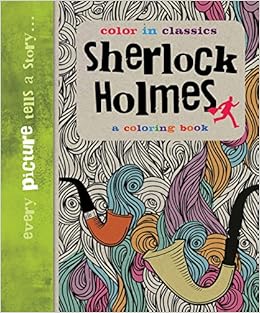
Sherlock Holmes: Color in Classics by Simon Balley (Mar 2016)
Color in 70 pages of scenes related to the classic Holmes stories.


The Great Detective: The Amazing Rise and Immortal Life of Sherlock Holmes by Zach Dundas (June 2015)
A journalist and lifelong Sherlock Holmes fan explores Doyle's original tales to reveal how they laid the groundwork for a myth of seemingly infinite variety in literary and screen adaptations.

The Big Book of Sherlock Holmes Stories edited by Otto Penzler (Oct 2015)
A massive collection of Sherlockian tales, presented by an Edgar Award-winning editor, features more than 80 stories about Holmes and Dr. Watson.


Recommendations for Teens:
The Clockwork Scarab by Colleen Gleason (Sept 2013)
In 1889 London young women are turning up dead, and Evaline Stoker, relative of Bram, and Mina Holmes, niece of Sherlock, are summoned to investigate the clue of the not-so-ancient Egyptian scarabs - but where does a time traveler fit in?

Lock & Mori by Heather W. Petty (Sept 2015)
In modern-day London, sixteen-year-old Miss James "Mori" Moriarty is looking for an escape from her recent past and spiraling home life when she takes classmate Sherlock Holmes up on his challenger to solve a murder mystery.

A Study in Charlotte by Brittany Cavallaro (Mar 2016)
Sherlock Holmes and Dr. Watson descendants, Charlotte and Jamie, students at a Connecticut boarding school, team up to solve a murder mystery.

 
Down the Rabbit Hole: An Echo Falls Mystery by Peter Abrahams (Aug 2008)
Like her idol Sherlock Holmes, eighth grader Ingrid Levin-Hill uses her intellect to solve a murder case in her home town of Echo Falls.

 
 Recommendations for Children:

Sherlock, Lupin & Me: The Dark Lady by Irene Adler (Feb 2014)
While on summer vacation at the seaside, twelve-year-old Irene Adler meets the young Sherlock Holmes, and his friend Arsene Lupin - and when a dead body floats ashore the three young friends set out to solve the mystery. 
Sherlock Holmes in The Hound of Baskervilles by Jennifer Adams (Sept 2013)
This board book introduces sound using characters, places and events from Arthur Conan Doyle's "The House of Baskervilles."
Sherlock Holmes and a Scandal in Bohemia adapted by Murray Shaw (Nov 2010)
Retold in graphic novel form, Sherlock Holmes attempts to retrieve a photograph being used to blackmail the King of Bohemia and finds something even more valuable.
The Sherlock Files: The 100-Year-Old Secret by Tracy Barrett (Mar 2010)
Xena and Xander Holmes discover that Sherlock Holmes was their great-great-great grandfather when they are given his unsolved casebook, from which they attempt to solve the case of a famous missing painting.

Friday, January 8, 2016

So You Want to Be a Reference Librarian


We here at the 5 Minute Librarian try to write for every type of librarian, from children's services through academia, and everything in between. We know that the world of librarianship is vast and varied, and we are but three people. As such, we have decided to speak to some librarians in other areas, and learn more about their particular specialties. This week, we reached out to the phenomenal Tina McEvoy, who works as the Assistant Director and Reference Librarian at the Lawrence Library in Pepperell, MA, to talk to us about her job, and what you might need to know if you aspire to be as awesome as she is.


So You Want to Work at a Public Library Reference Desk

I've worked at various reference desks, from community college and university libraries to small town public libraries, over the past 20 years. While some things have changed dramatically in that time (hello online databases!), many of the basics have remained constant. I'm going to assume that anyone looking for reference work is already a Google ninja and database super user. If you're not, you need to be!

This list is geared toward working in a public library. Everything on it is applicable to working in a college or university library as well, but academic libraries have the exciting extra challenges of faculty, course reserves, and incoming freshmen.

This is what I would tell anyone new to reference work:

Know Your Community

  • If you are working in a town where you do not live, familiarize yourself with the geography of the community – where are the schools, stores, gas stations, post office, cemeteries, nearest hospital, etc. What towns are nearby? How do you get to the highway? What local newspapers are there? Is there a business association? Senior Center? Preschools? You should be able to answer any type of “Where is the ...” question quickly.
  • Beyond the physical aspects of the community, you should find out more about who lives there. Check out the town demographics for a idea of the population makeup. Are there a lot of children, or maybe seniors? Do most people own a single family house, or rent an apartment? What is the average level of education and income? What languages are spoken at home? What  industries do people work in? Is there a large military presence? Then, pay attention to who comes in the building. Get to know the regulars – who's going to need help on the computers, who likes to see the newest mysteries, who wants you to save the coupon inserts from the newspapers. This makes the patrons feel welcome and wanted, and goes a long way to forging good feelings about the library in the community.

  • If the town has any interesting history (famous residents, important businesses, Revolutionary War ties, etc.) read up on it! You must be able to hold your own in conversation with the town history buff, or the genealogy researchers who just arrived from Kansas to learn about their ancestor who was at Bunker Hill.

Know Your Building

  • Be prepared to give impromptu tours of the building to new patrons or out of town visitors. Know when it was built, and by whom. Have a few interesting things to point out to people, or favorite spots for reading. Know what events are going on that day/week/month.

Know Your Collection

  • Know your fiction and nonfiction collection. This is really, really important. I rarely ever use print reference material any more, and have drastically weeded the reference collection at my library, but I am always helping people find circulating nonfiction books to fill their needs. Walk the stacks as often as you can (offering roving reference help as you go!), and keep an eye on the reshelving carts. If you participate in collection development, you'll already have a good idea of what your collection has and what is new, if you don't do collection development then pop in to the cataloging area to see what's coming in. Make a note of what areas you have good coverage for, and what areas need help. You should be able to go right to the area for a particular topic, and have a good idea of what you're going to find there. For fiction, it's always helpful to have a few suggestions ready to go for that patron who just wants “something good to read”, even if reader's advisory is not usually your job.

Know Your Patron

  • The patron will not usually ask for what they actually want/need (i.e., the customer is never right.) You need to nail the reference interview. The first question I always ask is “are you asking for someone else, or yourself?” Then I try to find out what they need the information for. So, someone comes in and asks where we keep the dog books. I could just tell them 636.7, or I could investigate more. Maybe they're looking for books on puppy training or different breeds – or maybe they're looking for a memoir about a guy who drove across the country with his dog that they saw on the Today show. If they are looking for a specific book, don't assume they have the title or author right. I always check first in Amazon, Ingram, or even Wikipedia to verify what it is first, then search my catalog.
  • Keep in mind the types of questions that you can't answer (legal, medical) , and do not provide any more information than referrals to the proper professionals to answer those questions.

Know When to Teach and When to Do

  • Know when to take the opportunity to teach someone how to do something, and when to just do it for them. If you have a parent with a child, and the parent is asking all the questions for the child, try to speak directly to the child. Make eye contact. Show them how you are searching the catalog, and then how to find something in the stacks. If you have a person who needs a certain tax form but has never used a computer you should ask them – do you want me to show you how to do it, or would you like me to just print it for you? If you, and the patron, have the time it can be a great opportunity to teach someone a new, useful skill – or you can make their day by having what they need in their hand in just a minute!

Know Your Technology

  • You had better be able to clear a paper jam and change the toner, but you should also how to clear the printer queue, where to find the wifi printer's IP and then what to do with it. Know how to download ebooks through whatever system your library uses, but don't feel like you have to know how to use every different mobile device. Use social media to promote your library and reach out to patrons. Know how to use your projector, A/V equipment, fax machine, scanner, video game consoles, etc. 

Additional Tips

  • Read the local news. Know what's going on in the town and state.

  • Be prepared for constant interruptions – plan your work in short chunks, and keep lists. I find that reading book reviews, ordering books, and working on fliers are good tasks to do at the reference desk.

  • Project confidence – you don't have to know all the answers, you just have to be willing to look for them!

  • Respect your patrons and their right to privacy. Tempting as it may be, do not post hilarious stories about your weird patrons on social media. Don't gossip about them to your coworkers. Your patrons should be able to count on confidentiality.

  • Learn how to disengage from overly chatty patrons. Have a plan for getting away from that patron who treats you like a bartender/therapist - “It's been nice seeing you, Sally, but I've got to get these papers over to the director!”


Tina McEvoy is the Assistant Director at the Lawrence Library in Pepperell, MA. She started her career as a periodicals acquisitions assistant, and then she caught a lucky break when she was offered one shift a week at the reference desk!

Friday, January 1, 2016

Weeding Challenge - Staying Trendy

A few weeks ago, we here at the 5 Minute Librarian gave you a crash course in Weeding 101.
I mentioned that you need to take the time to go through your collections every so often and see what's old and needs updating. I even joked: "Do you really want to be the library that still has the biography of Milli Vanilli on the shelf?"

Here's the thing, though: When did Milli Vanilli become so old that it's a joke to have their biography? Yes, they're from the 1980s, so this is an extreme example, but there had to be a point when it was time to weed that book from the collection before it was silly to have it. Today, we challenge you to think about staying on top of cultural trends, so your library can be current.

The Challenge

In many sections of the library, especially fiction books, you can get away with not weeding for a while. To stay on trend, though, there are some books that should be looked at annually. These include:
  • Sports and sport teams
  • Actors/Actresses
  • Singers, bands, and musicians
  • Movie and TV tie-ins
 Let's take a closer look, shall we?

Sports and Sports Teams

This stuff changes fast. A player who is beloved to everyone in your corner of the world could leave or be traded to another team or city, and be irrelevant to you (or worse) in the blink of an eye. In Massachusetts, the sports world consists mostly of the Boston Red Sox, the Boston Bruins, and the New England Patriots. There are other teams around, but these three may as well be the Holy Sports Trinity. I'm a casual fan; that is, if the game is on I will take a glance at the score, cheer for the local team, and go back to what I'm doing. I do not follow sports closely enough to know anyone except the major players.

That said: I have a story for you, about why you should remain current on this topic. Years ago, while still in library school, I worked at an independent bookstore, where the owner got "this AMAZING deal!" on the biography of Johnny Damon - he bought probably 200 copies of this book. (For those not in the know, Johnny Damon was one of the most popular players for the Red Sox, and had professed that he would NEVER play for the New York Yankees-one of the biggest rivalries in sports. And then, they offered him a lot of money, and he left Boston to play for New York. To sports fans, it was as if Boston itself had been stabbed in the back.) Anyway. My boss decided to put these books on display, a scant year after he had gone to the Yankees. I had one very nice, kindly older lady tell me that she "wouldn't even take a book about that Despicable Rattlesnake if it was free with purchase!"

Don't forget to take a look at the team books, too. Sure, the local football team is the same team, but your books about them might have information about "current" players who have since retired, or may not have information about recent seasons. Check out the sports almanacs, too - these should be updated every year, and then you can get rid of the old ones.

Actors, Actresses, Politicians, and Celebrities

It's a cruel world out there, and someone with the spotlight can suddenly be pushed into the shadows. Not to add to their torment, but if they are no longer on television or in movies, they are fairly irrelevant to us, too. Check the shelves, and check the statistics.

This is particularly true for child- and teen-actors. Even if they are still working and culturally relevant (good for them!), they have probably changed drastically. Take Miley Cyrus, for example: she went from country-pop Hannah Montana to a completely different type of pop artist. You might want to get rid of the books about her as a brunette child, and pick up a new one about her avant garde adult lifestyle.

This is also the time of year when we can take a look back at the previous year's major events, and act accordingly. I have weeded every Bill Cosby book from the children's department, due to recent developments. I also bought every single book I could find about Malala Yousafzai (who is not exactly a celebrity, but she is relevant and out there, and I am personally just amazed by her). And, sure, you might have a patron-base who needs to read all about Donald Trump, but he, and many other politicians, may be in next year's dust bin.

Singers, Bands, and Musicians

A lot of this rings true for musicians and singers, too. Have they had an album come out recently, or will they be working on a new one? Do they still have a strong fan-base, or were they teen idols who have out-grown their cherubic innocence? It's hard for me to know what's on trend and what's not, so I find the easiest way to answer this is to ask the patrons - particularly the teens. "Hey guys, does anyone care about One Direction anymore? Okay, back on the shelf it goes." If you're not comfortable doing this, you can always see if they have tours/album ongoing or coming up, or even take a look at your ordering system and see if anyone is still writing books about this particular artist. If nothing new is coming out, you may not need the old things, either.

Movie and TV Tie-Ins

This is particularly helpful for me in the children's room, but there are movie and book tie-ins and novelizations for all ages. For example, Bear in the Big Blue House is not on television anymore, so I can probably get rid of books starring those characters. Likewise, once Castle goes off the air, people will forget about the books "by" TV character Richard Castle (played by the adorable Nathan Fillion, who himself will always be relevant). We can also get rid of the behind-the-scenes-of-filming for older movies and shows.

A Caveat

This is not to say that we need to get rid of every single book about a person/band/sports team that is no longer new and exciting. There are hundreds of books about people who have achieved a sort of icon status, and just because The Beatles aren't around, doesn't mean you have to weed books about them. I'm just saying, you don't have to have books about the ephemeral celebrities, once their 15 minutes of fame is over.

So, what's to be done?

As we said last time, the first thing to do is to take a good look at your circulation statistics; if a book isn't going out, it's probably passe. There are also many titles that, for whatever reason, get missed on the statistics (for example, if the call number has a space in front of it in the computer system, it won't appear accurately if you sort by call number), and for this reason, I recommend doing an actual Shelf Check. Heck, print out the stats and bring them with you!

We at the 5 Minute Librarian would love to see what gems you've uncovered by weeding! Follow us on Twitter, and like us on Facebook, and make sure you never miss an article.

Friday, December 25, 2015

Library Mascots, Part 2

Months and months ago, we published a post about Why Your Library Needs a Mascot, and we thought that, since it's the holidays, it might be fun to show off some of YOUR library mascots! BEHOLD!


Henry, from AUT University in Aukland, NZ


The Cockroaches at the Niles District Library, Niles, MI


Marigold the Guinea Pig, Mansfield Public Library, Mansfield, CT

Marigold rocketed the old book drop off to be painted


Rufus the Bobcat, Montana State University Library


 Shawn, the Guinea Pig at the Hampton Bays Public Library, Hampton Bays, NY

Santa is star-struck by meeting Shawn


Captain Cushwa-Leighton, Cushwa-Leighton Library, St. Mary's College, Notre Dame, IN


Booker T. Dragon, Gretna Public Library, Gretna, NE


Gnoman, the Roamin' Gnome, Southwest Baptist University Libraries, Bolivar, MO


Spoticus, Metropolitan Library System, Oklahoma City, OK


REPETE, Pine Grove Middle School Library, East Syracuse, NY


Biblioraptor, Rutgers University Libraries, Camden, NJ


Thank you to everyone who shared their mascots! We love seeing all your great ideas. Feel free to share with us on our Twitter or Facebook page, or comment here.

Don't forget to check out our previous post, Why Your Library Needs a Mascot.

Friday, December 18, 2015

Ready-to-Go Book Display: Origami

Welcome to our series, "Ready to Go!" Book Display. Once a month, we'll highlight the latest or greatest for every age group (Adults, Teens and Children) that you can promote within your library or order for your collection. 

Encourage staff and patrons to create origami for your display!


Recommendations for
Adults:
 
A collection of 3D origami designs and techniques.

Image of item
Floragami by Armin Taubner (Mar 2014)
Create stylized versions of real flowers, whimsical fantasy flowers, and beautiful floral balls and wreaths - 40 designs in all - using cut, folded, and glued paper.

Image of item
Origami for Busy People: 27 Original On-the-Go Projects by Marcia Joy Miller (Nov 2011)
This little book provides a variety of shorter and longer projects than can be completed during a coffee break, over lunch, or whenever a mini vacation is required.

Image of item
The Lost Art of Towel Origami by Alison Jenkins (Oct 2005)
Stun your guests by skillfully creasing and crinkling your linen into works of art.
Image of item
Uber Origami: Every Origami Project Ever! by Duy Nguyen (Mar 2010)
Includes instructions for creating origami animals, mythical creatures, man and machine, holiday origami, and irregular origami.
Recommendations for Teens:

Image of item
Kusudama Origami by Ekaterina Lukasheva (Jan 2014)
A kusudama is a traditional Japanese sphere formed by modular origami construction techniques. This guide presents instructions for more than forty elaborate kusudama that range in shape from stars to flowers to pinwheels.

Image of item
Twenty adorable all-new designs are perfect for anyone who loves fashion, friends, and folding.

 Image of item
Waiting to Forget by Sheila Kelly Welch (Oct 2011)
T.J. and his sister, Angela, learn how to move forward and be happy while in foster care.

 Recommendations for Children:
Image of item
Kitanai the origami dog introduces soil and discusses the different layers, including topsoil, bedrock, and subsoil.

Image of item
A pirate girl travels through mountains, valleys, a cave and finally by sea to reach the treasure her grandfather has hidden for her, in an imaginative adventure that lets the reader recreate the story through an origami activity at the end.

Image of item
The Strange Case of Origami Yoda by Tom Angleberger (Mar 2010)
Sixth-grader Tommy and his friends describe their interactions with a paper finger pupper of Yoda, worn by their weird classmate Dwight, as they try to figure out whether or no the puppet can really predict the future. Includes instructions for making Origami Yoda.

Image of item
 Sadako's Cranes by Judith Loske translated by Kate Westerlund (Sept 2015)
Sadako, who survived the nuclear blast at Hiroshima but develops leukemia years later, learns that folding one thousand paper cranes will grant her one wish, and she sets out on her task, hoping to recover from her illness.

Friday, December 11, 2015

Spoilers, Sweetie

I am excited to announce a new segment to the 5 Minute Librarian titled: Spoilers, Sweetie!. This segment will be very different from our other ones because we're starting it with a call for help:

We're looking for readers who can help us write spoilers! Here's your chance to join the 5minlib team and help librarians everywhere! If you like to read and your soul doesn't die when you share a spoiler, this is for you!


Scandalous, I know. But let's look at the facts:

#1. More Books are Published Than You Can Read in a Year

Even if you read a book a day, you won't be able to read every single new book that is published. (Just in YA Lit alone, Goodreads lists over 1,400 YA books were published this year.) That doesn't even cover all of the books that are currently in your collection that you haven't even read yet. If you are a new librarian who isn't familiar with previous publications, good luck to you! 

#2. Librarians Aren't Paid to Read

Wouldn't it be wonderful if all we did was sit, read, and then recommend? We all love reading -- you can't get into this profession without it -- and we're expected to know our collection, but reading must be done on our own time. I get it -- it is hard to justify paying someone to read when librarians are needed for circulation, ordering, programming, teaching classes, patron help, etc. But this is our FREE time we're talking about and many of us are also balancing second jobs, families, and so many other commitments. How many books can we realistically read? It is never enough.

#3. Librarians Don't Love Every Genre or Book They Read 

Not only do you need to read on your own time, but it's also in genres and titles that you don't even enjoy. Wouldn't it be nice to read a bunch of spoilers and then pull the book off the shelf to read a few chapters for the reader's advisory info? It doesn't take long to figure out the pacing and style of writing. Five minutes and you have a new book under your belt that you can booktalk for the appropriate audience.

#4. Why Spoilers?

Let's be honest. Librarians have NEVER read every book that is published. It isn't possible! So, many people have found other ways to build their RA toolbox. I've heard of reading lots of reviews to skimming books to bouncing around on audio books. We're putting in so much time and effort to become acquainted with as many books as possible. 

But it isn't a perfect system. For starters, if you are anything like me, as you're trying to skim, you become hooked in the book and end up reading it anyway. If I knew the spoilers ahead of time, I wouldn't have that problem. Other people struggle with this because they worry about content warnings -- how much sex, violence, and death are in this? The only way to know for sure is to finish the darn book.

#5. Are You Worried You'll Kill the Love For Reading?

All of our posts will list the titles at the top of the page and we'll link them to their spoilers and back up to the top. We don't want to spoil anything you really want to read. In fact, we are hoping that this series will free up your evenings so that you CAN actually read what you want to. Because we love reading. We already have To-Be-Read book lists that we'll never finish. But we all also have genres we're not interested in and popular books that we just cannot make ourselves read. Let us at 5minlib do that dirty work for you!

#6. What Can I Do?

If you enjoy reading and willing to write up spoilers, please fill out this form: http://goo.gl/forms/vnyNHujIfO. We are going to begin this series by spoiling the award-winning books. You'll get to pick what book(s) you want to read and must be able to submit spoilers within a reasonable deadline (one month). It is simple, and the more people who participate, the quicker we can share these spoilers with everyone and possibly branch out to other niche-genres. You will be credited for your work!

#7 And What is With this Title? 


For those of you who don't know, I'm about to up your geek cred a little bit:
On Doctor Who, the amazing BBC sci-fi series, the Doctor has a (super awesome) love interest named Professor River Song. Since they are both time travelers, they don't tend to meet in the right order - one may have already had an experience that the other has not yet had. In order to keep things exciting, River Song discourages speaking about these things, with the warning: "Spoilers, Sweetie." We love that phrase and decided to name our series after it.

Friday, December 4, 2015

Weeding 101

One of my favorite, but often overlooked, aspects of librarianship is weeding.  It's a good thing, every so often, to take a look at our collections in specific areas and weed out the old, junky stuff, and think about getting some nice, shiny, new stuff that will last us a while longer. I try to weed on a schedule throughout the year, but when something comes up - a holiday, a new season of sports - it's nice to take a look at that aspect of the collection. "Hey, I keep hearing about the Red Sox. Is our sports section up to date?"

Weeding 101

If you're new to weeding, or librarianship in general, you might wonder why we get rid of perfectly good books. There are several reasons, including:

  • If a book isn't circulating and hasn't for a while, it is taking up shelf space that could be used for something that would circulate.
  • It's nice to have a robust collection, but too many books on a shelf means that people won't take the time to browse through them - it's overwhelming. It sounds counter-intuitive, but fewer books on a shelf means more overall circulations. 
  • Sure, it's in perfect condition, but do you really want to be the library that still has the biography of Milli Vanilli on the shelf?

Here are some things to look out for when going through your collection:
  • Circulation statistics - I often start a weeding project by looking at the statistics. Have these books circulated in the last 2-3 years? If not, is it something that is important to have? Here in the realm of the Children's Room, we keep a lot of things that don't circulate too often, because I would so much rather have something and not use it, than not have it when needed. Such as: anything involving child abuse, parents going to prison, death... I hope these books aren't needed, but I'm not pulling them just in case they are. (I will, however, make sure they're not old and crusty.)
  • Age - Do you have books that are "perfectly fine" but super old? Perhaps there's a newer version where everyone isn't wearing bell-bottom jeans in the pictures. I try to make sure any books I weed are at least 5 years old, but that depends entirely on your own collection. In many Young Adult collections, a 5 year old book is positively ancient. The CREW Method gives great age guidelines for each section of your nonfiction.
  • Condition - Obviously, anything moldy, musty, dusty, yellowed, or falling apart should be either replaced or gotten rid of completely.
  • Usefulness - Okay, so the book is great shape, and it goes out every so often. But do you really need 5 different biographies of Rutherford B. Hayes? That's up to you.

Replacement

If you use an ordering system like Ingram, you can scan in the book's ISBN (or type in the title) and it will bring it up for you. You can then click the Dewey number and it'll give you a list of other books (possibly newer and better books!) with the same Dewey number. How easy is that?! For example, I recently decided that, since it's December, I should take a look at my DIY gifts section, and I am really glad I did (more on that in a second). When I scanned in the barcode, Ingram gave me the author, title, etc., and this additional information:
Ah, 745.5! Just as I suspected!
When you click on the linked Dewey number listed, it takes you to a list of titles that also have that number, which you can then sort as you see fit. On the left, you can search within your results ("you know, I have nothing about paper airplanes"), or refine your results by clicking on format, age range, price, etc. I like to first refine my books by age range, and then sort by Ingram Demand (using the drop-down menu at right) - this gives me the titles that have been bought the most recently, which means they're the popular ones which will circulate, which is what I want.
So many books to choose from!

For Example...

Since it is December, I've decided that I needed to give a little TLC to:
  • DIY gifts
  • cooking/baking
  • kids holiday books
I found the best "gems" in the gifts/crafty section. Somehow, these titles didn't show up last time I went through here, but they have not circulated in two years, and as such, I got rid of them. 
Celebrate Helen Keller's birthday by learning sign language, and learning
about the 5 senses, 2 of which poor Helen couldn't use.
The only book I was really undecided about was Rosie O'Donnell's Crafty U: 100 Easy Projects the Whole Family Can Enjoy All Year Long, which had some really cute craft ideas. I weighed the pros and cons of this one. PROS: Cute ideas, in fairly good shape. CONS: Has not circulated, some ideas are dated, Rosie's show isn't on TV anymore, so she's not a name that people are on the lookout for. Ultimately, I decided to weed the book, because I realized, upon taking a closer look, that some of the pages were badly torn. But that's the best part of weeding - it's all up to you. You have the final decision on whether something stays or goes. Even if the book hadn't circulated and Rosie isn't on TV anymore, if I decided that I liked the ideas in the book, I could decide to put it right back on the shelf. 

Total time taken: 3 hours
Total books deleted: 14
Total new books ordered: 4

I always love finding books to weed. It's especially fun when it's a new collection and you don't know what you're going to find, but even in a place where you've been for a while, it's fun to get your collection into shape.

I'd love to hear about some of the more interesting things you've found while weeding! You can leave us a comment here, on our Facebook page, or on Twitter.

(Please note: this blog post was written by Kat.)